
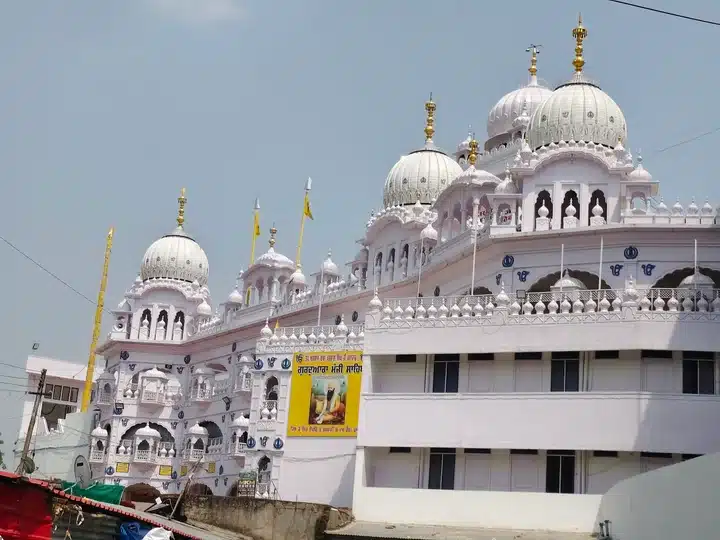
Located in the serene folds of the Shivalik hills in Himachal Pradesh lies a spiritual sanctuary that blurs the lines between history, mysticism, and the supernatural. The shrine of Dera Baba Vadbhag Singh ji (also known as Baba Gurbarbhag Singh), situated in the quiet village of Mairi within the Amb Tehsil of Una district, stands as an extraordinary epicentre of faith.
For centuries, this revered site has attracted a steady stream of pilgrims, scholars, and individuals seeking liberation from afflictions that standard science struggles to quantify. From its deep roots in Sikh lineage to its legendary battle against malevolent spirits, the Dera remains one of the most intriguing cultural and religious landmarks in northern India.
Geographical Setting and Accessibility
The journey to Dera Baba Vadbhag Singh is as scenic as it is spiritually profound. The shrine is positioned approximately 3 kilometres northeast of Nehri village. Nehri itself is a pivotal transit point along the bustling Una–Amb–Nadaun–Hamirpur highway.
For travellers coming from the district headquarters of Una, the Dera is located roughly 40 kilometres away. The approach road winds through the undulating, lush terrain characteristic of the lower Himalayan foothills—a landscape historically known as the Jaswan Hills. The geographical transition from the flat plains of Punjab to these spirit-haunted hills mirrors the spiritual journey pilgrims undertake when visiting this ancient site.
Historical Foundations and Sacred Lineage
To understand the immense reverence commanded by Dera Baba Vadbhag Singh, one must trace the saint’s impeccable lineage. Born in 1715 A.D. in the historic town of Kartarpur (District Jalandhar, Punjab, India), Barbhag Singh was born into a family of profound spiritual aristocracy.
He was the son of Baba Ram Singh and Mata Raj Kaur. Crucially, he was a direct descendant of Dhir Mal, who was the first cousin of the tenth Sikh Master, Guru Gobind Singh Ji (referred to historically as Dasam Padshahi). Due to this distinguished lineage, Barbhag Singh eventually succeeded to the hereditary gaddi (religious seat) of the Sodhis of Kartarpur, inheriting vast spiritual authority and responsibility.
From his early childhood, signs of his extraordinary destiny were apparent. Local lore recounts a telling incident from his youth.
While playing with his friends, a playmate jokingly commented on his wild, dishevelled hair, teasingly remarking that he looked like a bhoot (ghost or evil spirit). Standing nearby was Shradhanand, an astrologer and palmist of immense repute. Observing the young boy, Shradhanand gently corrected the playmate, predicting that Barbhag Singh was destined for greatness: he was not a bhoot, but would instead become the guru (master and subduer) of all bhoots.
The Flight to Jaswan Hills and the Miracle of Darshani Khad
The turning point in Baba Gurbarbhag Singh’s life coincided with a dark chapter in Indian history. In 1756, during the devastating fourth invasion of India by the Afghan ruler Ahmad Shah Abdali, the town of Kartarpur was systematically pillaged and set ablaze. Seeking to protect the sanctity of his spiritual lineage, Baba Vadbhag Singh escaped into the safety of the hill state of Jaswan.
The hot pursuit by Afghan forces did not deter the saint. As the enemy closed in near the village of Nehri, Baba Gurbarbhag Singh found himself at the banks of a modest mountain streamlet. Facing imminent capture, he knelt in intense prayer.
According to legend, his supplication triggered an instantaneous, violent flash flood down the dry bed. The sudden wall of water completely swept away the pursuing forces, securing his escape. Today, this streamlet is known as Darshani Khad, a sacred spot where pilgrims pause to pay respects before reaching the main shrine.
The Confrontation with Nar Singh
Following his miraculous escape, Baba Vadbhag Singh retreated further into the dense, uninhabited forests of Mairi village. He chose the shade of an ancient Ber tree (Ziziphus jujuba) as his site for intense meditation (tapasya).
However, this region was far from peaceful. The hills were believed to be the domain of Nar Singh, a highly potent and volatile astral entity or demon. Nar Singh possessed shapeshifting abilities and struck terror into the hearts of the hill folk.
Characteristics of Nar Singh
Appearance: He frequently manifested in dreams as a handsome, teenage Brahmin youth clad entirely in pristine white garments.
Malice: He was known to cohabit with women in their sleep and inflict severe psychological trauma, madness, physical sickness, and demonic possession upon anyone who dared trespass into his territory.
True to his aggressive nature, Nar Singh attempted to overpower Baba Gurbarbhag Singh using his full array of illusions and terrors. Yet the saint’s spiritual aura remained impenetrable. Utilising his immense meditative energy, Baba Gurbarbhag Singh subdued the demon, capturing him completely and trapping him inside an ethereal cage.
Instead of destroying the entity, the Baba channelled Nar Singh’s immense power toward a benevolent purpose. He bound the spirit to a sacred vow: Nar Singh was commanded to cure every single individual possessed by evil influences who visited the shrine with genuine devotion. Nar Singh conceded, and this legendary subdual laid the foundation for the Dera’s unique reputation as a place of miraculous spiritual healing.
The Mystery of the Soul-less Body
The passing of Baba Vadbhag Singh is shrouded in a poignant mystery that highlights the concepts of astral projection and absolute devotion.
One day, sensing that a group of his far-flung disciples were caught in a catastrophic crisis at a distant location, the Baba prepared to intervene using his spiritual powers. He strictly instructed his wife and family members under no circumstances to disturb him. He entered a secluded chamber, bolted the heavy door from the inside, and lay flat upon the floor. While his physical shell remained inert in Mairi, his soul flew across the skies to rescue his followers.
Hours turned into days. Distressed by his prolonged silence and fearing for his physical survival, the anxious family members eventually made the fateful decision to force open the door. Upon finding his cold, breathless, and seemingly lifeless body on the floor, they assumed the saint had passed away.
In accordance with sacred customs, they hastily prepared a funeral pyre near the very Ber tree where he had defeated Nar Singh and cremated the body.
[Soul Departs to Save Disciples]
▼
[Family panics due to prolonged absence]
▼
[Door broken open ➔ Body assumed dead]
▼
[Cremation begins at the Ber Tree]
▼
[Soul returns mid-cremation ➔ Physical vessel lost]
▼
[Spiritual promise made to reside near Dhauli Dhar]
Tragically, just as the flames engulfed the pyre, the soul of Baba Vadbhag Singh returned to re-enter its physical vessel. Finding his body consumed by fire, the astral spirit of the Baba spoke to the horrified onlookers.
Devastated by their blunder, the family and gathered devotees wept bitterly, begging the saint not to abandon them. Moved by their raw grief, Baba Gurbarbhag Singh gave them a comforting promise: though his physical body was gone, his conscious spiritual presence would reside permanently on a tree near the Dhauli Dhar waterfall, complete with his mystical cage to trap evil spirits for eternity.
Sacred Geography of the Dera Complex
The modern layout of Dera Baba Vadbhag Singh is an architectural testament to these historical narratives. The complex comprises several distinct sacred zones:
The Sepulchre and the Ber Tree: The main shrine building houses the sepulchre (Samadhi) of the Baba, constructed precisely where his funeral pyre once burned. Supporting this spiritual structure is the ancient, surviving Ber Tree, under which he first meditated and subdued Nar Singh.
Jhanda Sahib: Directly in front of the shrine stands a towering, majestic Sikh religious standard known as the Jhanda Sahib.
Bibi Bhani’s Sepulchre: Situated immediately to the right of the main shrine is the final resting place of Bibi Bhani, the devoted sister of Baba Gurbarbhag Singh, who walked alongside him through his trials.
Manji Sahib: Located approximately fifty yards outside the main compound is a distinct, beautifully domed Gurdwara structure called the Manji Sahib, dedicated to congregational prayers.
Charan Ganga (Dhauli Dhar Waterfall): Roughly 1.5 kilometres from the main Dera sits an all-weather, cascading waterfall known natively as Dhauli Dhar or Charan Ganga. This is the precise spot where the Guru took his daily baths. It is believed that the water carries its healing vibrations, making a dip here mandatory for all pilgrims.
The Annual Hola Mohalla Fair: Rituals of Exorcism
While the Dera sees visitors year-round, its spiritual energy peaks during the annual Hola Mohalla Fair. Held during the Vikrami lunar month of Phalgun (which overlaps February and March), the festival culminates on the night of the full moon (Purnima). The fair spans ten days—commencing a full week prior to the full moon and wrapping up two days after it.
The event draws hundreds of thousands of pilgrims from across northern India, including Punjab, Delhi, Uttar Pradesh, Rajasthan, and Himachal Pradesh. It acts as a massive gathering ground for individuals afflicted by negative energies, psychological disturbances, or what traditional folklore terms “malign influences.”
The Healing Ritual of the ‘Dolis’
The exorcism rituals performed at Mairi are intense and highly structured. The afflicted individuals, referred to endearingly as Dolis, are seated in orderly rows across the open courtyards. The process unfolds through a sequence of traditional sensory steps:
The Rhythmic Soundscape: A deafening, continuous rhythm is generated by beating heavy bell-metal platters (thalis) and large traditional drums (dhols). The precise vibration is meant to agitate the hidden entities inside the afflicted individuals.
The Inhalation of Incense: As the drumming reaches a crescendo, the Dolis are made to inhale the dense, pungent smoke of burning traditional incense. This combination causes the individuals to enter a trance state, tossing and violently swaying their heads in rhythm.
The Spiritual Confrontation: Through prayer and spiritual proxy, the malevolent entities within the Dolis are targeted until they agree to surrender. The exorcists demand that the spirit leave the human host and depart permanently for the Dhauli Dhar waterfall.
The Ethereal Engagement: The entity is questioned internally: “Have you reached the waterfall? Do you see Baba Vadbhag Singh standing there with the cage?” Once the host body affirms that the entity sees the Baba, it is commanded to step inside the cage. The host then begs Baba Ji to lock the cage forever. The moment the entity is metaphorically locked away, the convulsive movements stop, and the individual reports an immediate sense of peace and recovery.
The Hoisting of the Jhanda Sahib
The absolute emotional and spiritual peak of the ten-day fair is the ceremonial changing and hoisting of the Jhanda Sahib, which occurs exactly on the full moon day.
| Ritual Element | Frequency / Tradition | Cultural Significance |
| The Pole Source | Earmarked every 3rd year | A pristine pine tree, measuring 70–80 ft in height and 4–5 ft in diameter, is brought from the forests. |
| The Dehoisting | Annual (Phalgun Purnima) | The old flag is brought down slowly amid intense, emotional chants and collective prayers (Ardas). |
| Sacred Relics | Instantaneous distribution | The old cloth, cowrie shells, coins, and betel nuts attached to the old pole are distributed; keeping them is considered a lifelong blessing. |
| The New Hoisting | Concludes the main fair | The new flag is raised, signaling the triumph of divine energy over darkness for the coming year. |
Sociological and Cultural Dynamics
The Dera Baba Vadbhag Singh represents a fascinating intersection of regional cultures. The vast majority of the regular votaries belong to the historic tracts of Punjab—specifically the Doaba, Majha, and Malwa regions. For these agrarian communities, a yearly pilgrimage to Mairi is an indispensable family tradition.
Historically, observers noted that the fair primarily attracted orthodox, rural, and illiterate populations, with a high concentration of women seeking refuge from psychological issues that lacked clinical avenues of treatment in past eras. In a modern context, however, the Dera has seen a shifting demographic. Today, educated urbanites, curious researchers, and diaspora Sikhs from across the globe visit the site.
While modern science classifies the phenomena observed here as mass hysteria, conversion disorders, or psychological catharsis triggered by rhythmic drumming, for the millions who make the trek to Una’s hills, the reality is simple: it is a place where suffering ends, where the heavy chains of unseen afflictions are broken, and where the eternal protection of Baba Gurbarbhag Singh continues to guard his flock.
How to Reach Mairi Village
Depending on your starting preference, the destination can be reached efficiently via road, rail, or air.
By Road
Road travel is the most direct way to reach the Dera, as it is well-connected to major highways.
From Una: The shrine is about 40 km from the town of Una. You can take the main Una–Amb–Nadaun–Hamirpur highway up to Nehri village, and then take the short 3 km link road northeast directly to Mairi.
Bus Services: State transport buses (HRTC) and private operators run frequent services from major Punjab cities (like Jalandhar, Hoshiarpur, and Amritsar) and Delhi to Una or Amb. From Amb or Una, local buses, shared tempos, and private taxis are easily available for the final stretch to the Dera.
By Train
Amb Andaura (AMBH): This is the closest railway station, located roughly 15 to 20 km away from the shrine. It is connected by direct trains from Delhi, including the Vande Bharat Express.
Una Himachal (UHL): Located about 40 km away, this is a larger station with excellent connectivity to Delhi, Chandigarh, and Punjab. Taxis and local buses run directly from outside the station to Mairi.
By Air
Gaggal Airport (Dharamshala): Located about 85 km away, this is the nearest airport, though flights can be subject to weather conditions.
Sri Guru Ram Dass Jee International Airport (Amritsar) or Chandigarh Airport: Both are roughly 140–160 km away. They offer broader domestic and international flight options. You can hire a direct taxi or take a bus from either airport to reach the shrine.
Where to Stay
Accommodation options vary depending on the level of comfort you prefer, ranging from community lodging to standard hotels.
At the Shrine Complex (Dharamshalas)
For devotees who prefer to stay close to the spiritual energy of the site, the Dera management and various community trusts operate several large Dharamshalas (inns) and community halls directly within Mairi village.
These offer basic, budget-friendly room block options or communal halls.
Free community kitchen food (Langar) is served continuously to all visitors.
Note: During the annual Hola Mohalla Fair, these spaces become incredibly crowded, and getting a spot requires arriving well in advance.
Standard Hotels in the Amb & Bharwain Area (15–20 km away)
If you prefer standard modern amenities, air conditioning, and a quieter environment away from the immediate festival crowds, looking toward Amb or the nearby highway towns is your best option:
Key Travel Tips
Timing Your Visit: If you are visiting to experience the cultural phenomenon of the Hola Mohalla Fair, plan for February or March. However, if you prefer peaceful meditation and want to avoid heavy traffic and massive crowds, plan a visit during the quieter autumn or winter months.
Local Terrain: The road from the main highway into Mairi involves typical low-hill terrain. If you are prone to motion sickness, keep appropriate remedies on hand.
